
From 2.82 per cent over a month earlier, India's COVID-19 case fatality rate declined to 2.72 per cent on July 10 and has further reduced to 2.49 per cent presently.

They agreed to continue technical exchanges to help end the epidemic worldwide as soon as possible, it said.
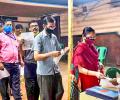
Union Health Secretary Rajesh Bhushan said upcoming festivals and mass congregations in different parts of the country may potentially facilitate transmission of infectious diseases, including COVID-19.
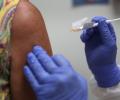
The Union health ministry has directed states to identify all left-out people and ensure everyone gets their Covid jab through initiatives such as workplace vaccination, as part of the government's "Har Ghar Dastak" campaign. Health Minister Mansukh Mandaviya held a review meeting on vaccination progress with Manipur, Meghalaya, Nagaland and Puducherry on Monday. In a tweet, the minister said, "Spoke about augmenting Govt's #HarGharDastak vaccine campaign. Requested help from religious leaders, NGOs & political groups to speed-up vaccination coverage." Health secretary Rajesh Bhushan has asked state officials that workplace vaccination should be organised for targeting people due for their doses.
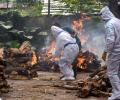
Given the robust and statute-based death registration system in India, while some cases could go undetected as per the principles of infectious disease and its management, missing out on the deaths is unlikely, the Union health ministry said.
So far, less than 1 per cent of the target population of 77 crore in the 18-59 age group have been administered the precaution dose.

India has one of the lowest cases per million at 1,469 as against the global average of 2,425, the government said.
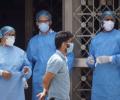
During a briefing on the COVID-19 situation, joint secretary in the ministry Lav Agarwal also said about 2.94 per cent of the active COVID-19 cases needed oxygen support, 3 per cent needed intensive care units (ICU) and 0.45 per cent required ventilator support.

The cumulative number of COVID-19 vaccine doses administered in the country crossed 86 crore.
Each state will plan it in two districts and preferably in five different session-type settings -- district hospital, community health centre or primary health care centre, urban site, private health facility and rural outreach.
The cumulative number of COVID-19 vaccine doses administered in the country crossed 82 crore on Tuesday, the Union health ministry said.
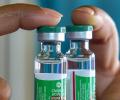
Earlier, it was reported that the judges of the apex court would get the option to choose between Covaxin or Covishield vaccines. Later, the Union health ministry, in a clarification, said the judges have not been given any such option to choose between both the vaccines, adding that it will be conducted entirely through Co-Win system.

The ministry, however, said it could not be sufficiently established yet if these variants were behind the recent spike in COVID-19 cases in some states.
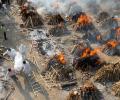
A second wave of Covid driven by the Delta variant engulfed the country in May-June bringing the health system to its knees and leaving people gasping for help.

It said the actual caseload of COVID-19 cases in the country as on date is 3,42,756, while more than 6.35 lakhs patients have recuperated from the disease.

India achieved a major milestone in its vaccination programme against COVID-19 as the cumulative vaccine doses administered in the country surpassed the 150-crore mark on Friday.
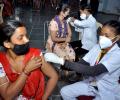
India achieved this coverage in 130 days as against the USA's feat in 124 days.

'This means that there is a higher likelihood of individuals who have recovered from COVID-19 to be reinfected with the Omicron variant'
Under the National COVID-19 Vaccination Programme, more than 148 crore vaccine doses have been successfully administered.

Continuing with the trend of the last nine days, India has reported more daily recoveries than daily new cases in a span of 24 hours.

The Union Health Ministry on Friday announced that those above the age of 18 years who have completed nine months after the administration of the second dose will be eligible for the precaution dose.
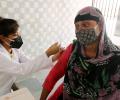
States and Union Territories would aggregate the demand of private hospitals for COVID-19 vaccines based on which the Centre will facilitate supply to these governments for timely and equitable distribution to smaller and remoter private healthcare facilities, according to the revised guidelines issued.

The states were advised to conduct surveillance and report district-wise severe acute respiratory illness and influenza-like illness cases on a daily basis and also to send these for genome sequencing to the mapped INSACOG laboratories.

The Centre on Thursday advised states slated to hold assembly polls in the next few months to ramp up COVID vaccination exponentially to protect the vulnerable population given the steady rise in cases of the Omicron variant of coronavirus in India.
According to health ministry officials, over 92 per cent of the adult population have received at least one dose while over 68 per cent have been fully vaccinated.
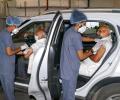
For the month of May, 4,03,49,830 vaccine doses have been made available by the Union Government to states.
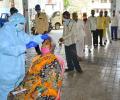
The Centre on Saturday strongly advised 12 states and Union Territories reporting a surge in coronavirus cases to significantly increase testing and ensure people follow COVID-appropriate behaviour, noting that one infected person could spread infection to an average of 406 individuals in a 30-day window without restrictions.

Indian billionaires saw their combined fortunes more than double during the COVID-19 pandemic, and their count shot up by 39 per cent to 142, while the wealth of the ten richest is enough to fund school and higher education of children in the country for 25 years, a new study showed on Monday. In its annual inequality survey released on the first day of the World Economic Forum's online Davos Agenda summit, Oxfam India further said that an additional one per cent tax on the richest 10 per cent can provide the country with nearly 17.7 lakh extra oxygen cylinders, while a similar wealth tax on the 98 richest billionaire families would finance Ayushman Bharat, the world's largest health insurance scheme, for more than seven years. The COVID-19 pandemic saw a huge rush for oxygen cylinders and insurance claims during the second wave last year.
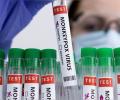
It underlined that anyone can catch the virus if they have had prolonged or repeated contact with an infected individual.
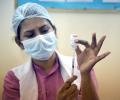
The Centre has asked states and union territories witnessing surge in new COVID-19 cases and high active caseload to continue with the strategy of 'test, track and treat' that had yielded rich dividends at the height of the pandemic and accelerate vaccination for priority population groups in districts reporting higher infections on mission mode.

India has entered a 'demographic sweet spot' with half of its population being under the age of 29. This 'demographic dividend' is likely to last for 2-3 decades and provides the government a unique opportunity to harness the vast potential of India's youth, points out Raj Kishore Mishra, the former civil servant turned development professional.

As many as 1,578 dedicated COVID hospitals are providing quality medical care.

India's woman Grandmaster Koneru Humpy said there wasn't enough encouragement for women to take up chess in the country.
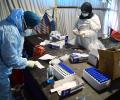
In a letter to states and UTs on Monday, Additional Secretary in the Union Health Ministry Arti Ahuja advised them to pay attention to this aspect immediately and increase the testing in a strategic manner keeping in view the trend of case positivity in specific areas.

'India's cases of death per million population is 14.27 while the global average is more than its four times, at 68.29'
While the global figure for COVID-19 cases per million is 5,552, India is reporting 5,790 cases per million population. The United States, Brazil, France, the United Kingdom, Russia and South Africa are witnessing much higher numbers.
The top court also took note of the submissions about objectionable public utterances by some groups and individuals.

Stressing on the need to protect both lives and livelihoods, he said public health action in India and across the world must be continually guided by evidence from four key questions -- how transmissible is the variant, severity of the disease it causes, how well vaccines and prior SARS-CoV-2 infection protect and how common people perceive risk and follow control measures.

Thirty districts in the country, including 13 in Kerala, eight in Mizoram, four in Meghalaya, three each in Manipur and Arunachal Pradesh, two in Sikkim and one in Meghalaya are reporting a weekly positivity rate of over 10 per cent.
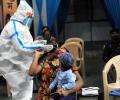
The Centre has deputed multi-disciplinary teams to states witnessing a surge in COVID-19 cases, including Maharashtra, Kerala, Gujarat, Punjab, Karnataka and Jammu and Kashmir, to support them in effectively tackling the pandemic.
 © 2026 Rediff.com - Advertise with us - Disclaimer - Privacy Policy - Sitemap - Feedback - About us - Terms of use - Grievances